

The cursor blinks in an empty search bar. You have typed and deleted three different questions in the last ten minutes. You cannot name what is wrong, but you know something has to shift.
Stuckness is a signal, not a failure
When you cannot phrase the question, you are not missing the starting line. You are standing on it. The I Ching is built for this exact moment because it does not require a crisp, well-formed inquiry.
It works with the shape of the situation, and a situation that feels like fog is still a situation. The inability to name the problem is itself a piece of information: the dynamic is complex, or you are too close to see it, or the real issue sits underneath the one you keep trying to articulate.
A cast at this stage often surfaces the pattern you could not put into words, and that alone shifts something.
Write the situation, not the question
Open a note on your phone or a blank page. Do not try to craft a question. Instead, write three or four sentences that describe what the past week has actually looked like.
Include a concrete detail: the conversation you keep replaying, the email you have not opened, the number of times you checked the same account balance. Then reduce that description to a single line, such as “My current situation at work” or “The dynamic between me and my partner right now.” This is your casting question.
It does not need to be elegant. It only needs to be true to the shape of what you are living.
The answer is a mirror, not a map
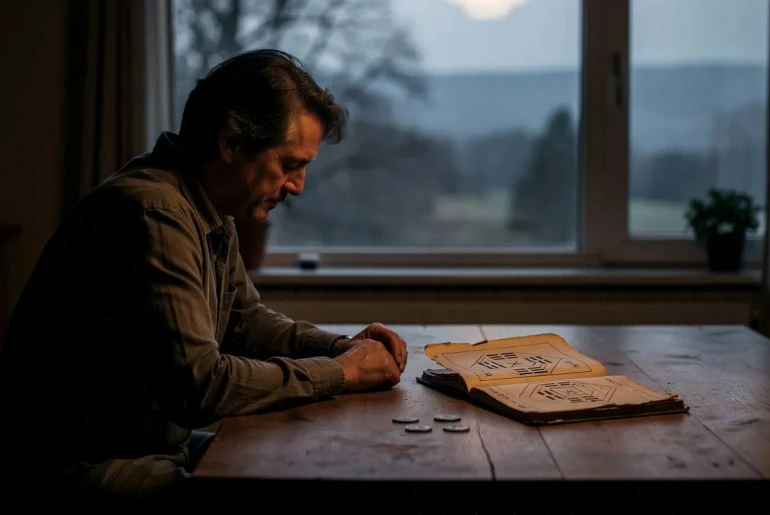
Once you cast, you receive a hexagram and possibly changing lines. Read the text not as a command but as a description of forces already in motion. If the image feels foreign, sit with it for a minute and ask: where in my life does this pattern show up?
The I Ching will not tell you to quit your job or leave your relationship. It will show you whether the current is moving toward resolution or stagnation, whether the obstacle is internal or external, whether the wise move is to act or to wait. You remain the one who decides.
Two hexagrams that often appear when you cannot name the problem
Stagnation (Hexagram 12) shows heaven and earth pulling apart, a time when communication breaks down and nothing seems to move. If this appears, the reading is not saying you are stuck forever. It is naming the current condition honestly and advising you to stop pushing. The small, quiet act of acknowledging the blockage is the beginning of its end.
Difficulty at the Beginning (Hexagram 3) depicts the chaos that precedes order, like a tangle of threads before weaving. When you cannot name your question, this hexagram often says you are at the very start of something new, and the confusion is not a sign of error but of growth. The advice is to gather your resources, take one small step, and trust that clarity comes through movement, not before it.
One thing you can do in the next ten minutes
Take a piece of paper. Write the words “I am stuck because…” and finish the sentence without editing, crossing out, or second-guessing. Write the first ending that arrives, even if it sounds trivial or dramatic. Then read it back to yourself. That sentence is the raw material for a casting question, and it often contains more truth than the polished versions you deleted.
The I Ching is a tool for reflection. It does not provide medical, legal, or psychological advice, and a reading does not tell you what will happen. It offers a pattern to consider, and the responsibility for any decision remains with you.
What should I do?
If the cast gives you Return (Hexagram 24), the turning point is near, and the doing is to notice the first small sign of change and act on it. The I Ching rarely prescribes a single action, but it will show whether the wise move is to advance, to pause, or to correct something that has gone off course.
What do I need to know right now?
A hexagram like The Abysmal (Hexagram 29) suggests you are in a flow you cannot control, and the knowledge you need is that you must keep moving through it rather than fight the current. The reading often reveals the underlying dynamic that your conscious mind has not yet named.
How do I get unstuck?
Cast with the question “What is blocking me?” If Oppression (Hexagram 47) appears, the block is external, a circumstance or a constraint you did not create, and the way out is endurance and a refusal to abandon your own integrity while the pressure lasts.
Should I stay or should I go?
The I Ching does not answer yes or no. A hexagram like The Wanderer (Hexagram 56) points to a period of transition where movement is part of the process, but it asks you to travel lightly, keep your connections temporary, and stay alert to where you are being received.
What should I be focused on?
If you receive Contemplation (Hexagram 20), the focus is on stepping back to observe the whole field before you act. The hexagram warns against rushing in and instead invites a period of clear, unhurried attention to the pattern that surrounds you.
How do I start to change?
Work on What Has Been Spoiled (Hexagram 18) points to addressing what has been neglected. Change begins not with a grand gesture but with a small, concrete repair: a conversation you have been avoiding, a task left undone, a habit you stop for one day.
When you are ready, cast a free reading at https://iching.today/.