
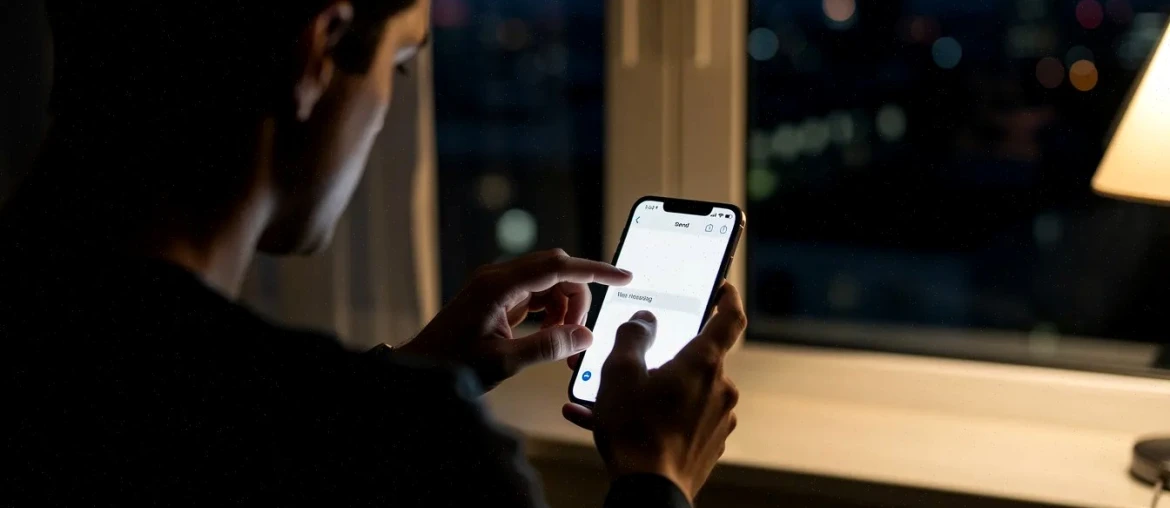
A draft has been sitting in your phone for two days, and you cannot decide whether to send it. The words are right there, edited and re-edited, but something stops your thumb every time. This is one of the most concrete decisions a person can face, and it is also one of the best possible uses of a single I Ching cast.
When the question is about a specific message, the oracle does not need to untangle decades of life story. It can reflect the energy of this one moment, this one recipient, and this one intention.
People come to the I Ching with this kind of question because they want clarity, not a fortune. They are not asking for a guarantee that the reply will be kind or that the relationship will transform. They are asking whether the act of sending aligns with the way things are moving right now. The I Ching, used thoughtfully, helps you see that alignment, or the lack of it, without pretending to control the outcome.
How the I Ching works with a single decision
When you sit down to cast about a message, you are not outsourcing your judgment. You are holding up a mirror. The hexagram you receive will describe a situation, a phase of change, or a quality of energy.
If the reading shows a time of waiting and nourishment, sending the message now might be like planting a seed in frozen ground. If it shows a moment of breakthrough and clear speech, the same message could land with unusual force.
The I Ching does not say yes or no. It gives you an image, and your job is to feel whether that image matches what you know in your gut. Many people find that the act of casting itself, the pause it requires, is enough to settle the question. You stop rehearsing the conversation and start paying attention to what is actually present.
Hexagrams that often appear in this situation
Certain hexagrams turn up repeatedly when people ask about sending a message, waiting for a reply, or speaking from the heart. Here are three that can guide you toward a more grounded decision.
Waiting (Hexagram 5)
Waiting, hexagram 5, describes a person standing at the edge of a stream, watching the clouds gather. The classic text advises patience, not passivity. If you receive this hexagram while holding a drafted message, the reading may be pointing to timing.

The message itself might be fine, but the conditions are not yet ripe. Sending it now could feel like shouting into a storm. Waiting does not mean abandoning the message.
It means letting the other person’s readiness catch up with your own. You can read more about this hexagram at Waiting (Hexagram 5).
Coming to Meet (Hexagram 44)
Coming to Meet, hexagram 44, is about an encounter that arrives without warning. It often appears when a message carries the potential to start something new, or to reopen a door that seemed closed. The hexagram warns against forcing the meeting and encourages you to be honest about what you are offering.
If you are rewriting the message to sound cooler or more detached than you feel, hexagram 44 might be nudging you to drop the performance. The encounter itself matters more than the polished words. Learn more at Coming to Meet (Hexagram 44).
Inner Truth (Hexagram 61)
Inner Truth, hexagram 61, speaks directly to the sincerity behind your words. The image is of wind moving over water, an influence that reaches deep without needing force. When this hexagram appears, the reading is less about whether to send the message and more about whether the message is true.
A message that comes from genuine care can move even a difficult situation. A message that hides resentment behind polite phrasing will create confusion. This hexagram asks you to check your own heart before you check the recipient’s reaction.
See the full description at Inner Truth (Hexagram 61).
These three hexagrams do not exhaust the possibilities, but they cover the most common dynamics: timing, the nature of the encounter, and the quality of your honesty. If you receive a different hexagram, look for the same themes. Ask yourself whether the reading describes a moment of action or a moment of holding still, and whether it points to something true in you that the message either expresses or conceals.
- Draft the exact message you are considering.
- Identify your true intention: what do you hope will happen?
- Sit quietly for a moment without editing the words.
- Cast your coins and note the hexagram.
- Read the hexagram as a description of the present, not a prediction of the reply.
Moving from the reading to the decision
Once you have the hexagram, do not rush to interpret it as a green light or a red light. A hexagram like Biting Through (hexagram 21) might suggest that a clear, decisive message is appropriate, but it does not promise that the other person will receive it well.

A hexagram like Obstruction (hexagram 39) might point to a blockage, but the blockage could be in your own hesitation rather than in the relationship itself. The reading is a conversation starter with your own intuition, not a final verdict.
One practical approach is to sit with the hexagram for an hour. Close the screen, set the phone aside, and notice what thoughts come up. If the reading describes a phase of waiting, you might feel relief. If it describes a moment of truth-telling, you might feel a surge of courage. Those feelings are part of the answer. The I Ching works best when you let it clarify what you already know but have not yet admitted.
Should I text him?
If you are asking this question, the real issue is often not the text itself but the silence that came before it. Before you cast, notice whether you are texting to reconnect, to get closure, or to fill an anxious gap. The I Ching can show you whether this is a moment for reaching out or a moment for letting the silence do its work. Trust the image you receive more than the fear that prompted the question.
Should I send that message?
A message that has been rewritten many times usually carries a weight that the words alone do not explain. The I Ching can help you see whether the weight is something true that needs expression, or something old that you are projecting onto this person. If the reading describes a time of inner clarity, send the message as it is. If it describes confusion or hidden motives, pause and rewrite from a quieter place.
Should I wait for them, or move on?
This question is about your own energy as much as theirs. The I Ching often reflects back the posture you are holding. A hexagram that shows stagnation might be telling you that waiting has already become an identity, not a choice.
A hexagram that shows gradual progress might suggest that waiting is still aligned with the natural pace of things. Either way, the reading helps you distinguish patience from self-neglect.
Should I tell her how I feel?
Speaking your feelings is rarely a mistake when the intention is clean, but timing and receptivity matter. The I Ching can reveal whether this is a moment when your honesty will be heard, or a moment when it will land on ground that is not ready. If the reading points to sincerity without attachment to outcome, you can speak with less fear.
If it points to a need for restraint, that restraint is not suppression; it is wisdom.
The next time a message sits unfinished on your screen, let the I Ching help you move from the loop of rewriting to the clarity of a single cast. You can cast a free reading right now at https://iching.today/ and see what the moment holds.